Looking for Something?
Video Education Library

10 Reasons to Buy Here
- 2 Year Frame Warranty
- 2 Year Lens Warranty
- 30-Day ℞ Guarantee
- Great Frame Selection
- Friendly & Experienced
- 50% Off 2nd Pair
- Latest Innovations
- Highest Quality
- Competitive Pricing
- Support Local Business
Secure Online Ordering
Order vision care products securely & conveniently from your home.
Begin Ordering Now
As a fully licensed and equipped optometric practice, Family Vision Center offers a complete range of eye care services to all our patients.
Whether the eye care issue involves correcting refractive errors with eyeglass or contact lenses, or helping a student find amazing frames, or diagnosing/treating eye conditions and diseases, our experienced team will identify and implement the best eye care solutions for you.
Eye Health Evaluation
With our years of experience in diagnosing and treating typical vision disorders such as nearsightedness, farsightedness, amblyopia, presbyopia, cataracts, macular degeneration and diabetic retinopathy, Dr. Kathy Hendrickson and her team are equipped to provide appropriate therapeutic medical eye care.
At the same time, the Family Vision Center team offers a wide array of high quality eye care products at reasonable prices. Our patients never pay too much for the best quality in eyeglasses, contact lenses, sunglasses, progressive and bifocal lenses, and outstanding service.
Treatment of Eye Disease
If you are diagnosed with an eye disease, you want the best treatment available to get your eyes healthy again. At Family Vision Center, we stay current with best treatment practices. Based on your diagnosis, we may recommend a wide variety of approaches, including improved nutrition, prescription medicines, therapy and vision exercises, or medical procedures.
Good Eyecare Begins With A Yearly Eye Exam!
Although many do not realize it, the best way to protect your vision is with a yearly eye checkup. Even a basic eye exam can instantly detect many health-threatening conditions, such as tumors, vascular irregularities, and diabetes-related injury to the retina. At Family Vision Center, that basic checkup is brief and painless.
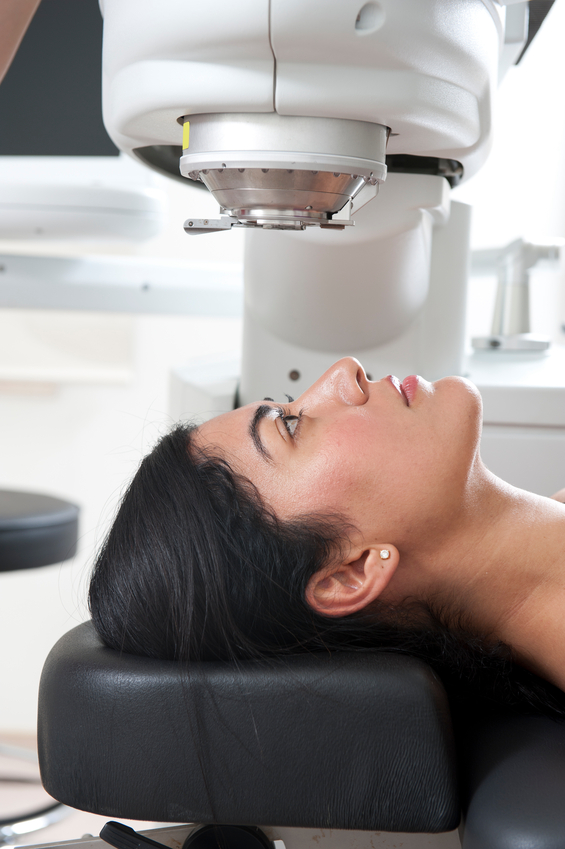
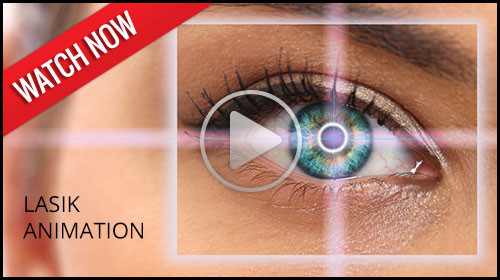
Other surgical alternatives have become available. Among these is a technique called phakic IOL implantation which involves implanting a lens behind the cornea, but in front of the iris. With this new option, many of those who were too highly nearsighted for LASIK are now candidates for refractive surgery.
If you are interested in refractive surgery, please let us know. Refractive surgery is not to be taken lightly. Detailed testing is necessary to determine whether or not you are a good candidate for the surgery. If testing shows you to be a good candidate, we can help you choose the refractive surgeon who is most appropriate for your case. In addition, we provide post-operative care for refractive surgery.
Annual eye exams are vital to maintaining your vision and overall health. In our continuing efforts to bring the most advanced technology available to our patients, Family Vision Center is proud to announce the inclusion of the iWellnessExam as an important part of our complete eye examination. Similar to an MRI or CT scan for the eye, the iWellnessExam uses spectral domain optical coherence tomography (SD-OCT) to produce cross sectional images of the retinal layers – which is sensitive area of the back of your eye – in a matter of seconds.
Many eye problems can develop without warning and progress without symptoms. In early stages, you may not even notice a change in your vision. But sight threatening conditions and diseases such as macular degeneration, glaucoma, diabetic retinopathy and others can be detected with a thorough exam of the retina, including the iWellnessExam.
The iWellnessExam is fast, easy, and comfortable for patients of all age and provides Dr. Kathy Hendrickson with valuable information about the health of your most precious gift – your sight.
The iWellnessExam provides:
- Detailed SD-OCT scan reports to show a healthy eye or detect early signs of disease.
- Thickness maps of the retina and ganglion cell complex giving your doctor detailed information simply not available with other methods.
- The opportunity for you to view and discuss your iWellnessExam scan reports with your doctor at the time of your exam.
- A permanent record for your file, which allows Dr. Kathy Hendrickson to compare your iWellnessExam scan reports each year to look for changes.
Measurements
Optikam's EY-Stick measurement device obtains eyewear measurements that take into account how the frame will be worn by the patient once dispensed.
These personalized “as-worn” measurements allow lens designs to be customized to take into account Vertex Distance, Pantoscopic Tilt and Frame Wrap.
As-worn measurements improve monocular Pupillary Distance measurements as well. The Pupilometer measures the monocular Pupillary Distances anatomically based on the center of the patient's face, whereas OptikamPad will obtain monocular Pupillary Distances using the mid-point of the frame which takes into account the frame fit and possible nose pad adjustments.
1 Picture 10 Measurements
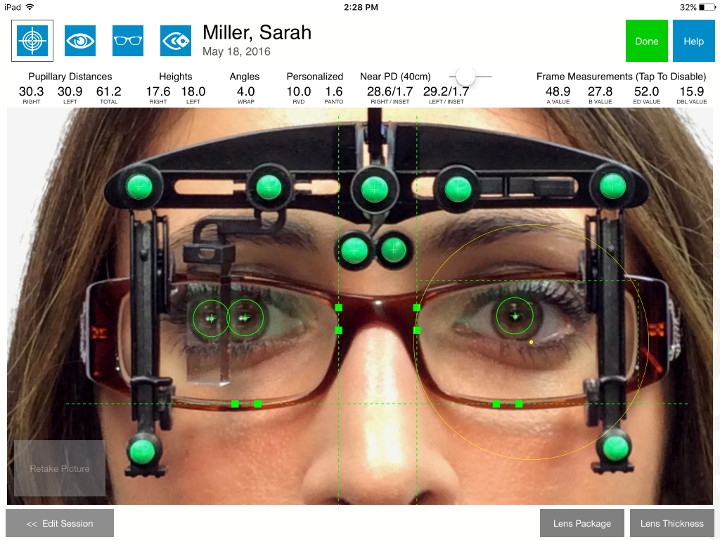 In the time needed for an ECP to obtain two measurements using a pupilometer and a Sharpie, OptikamPad provides the ten measurements needed for Position of Wear:
Monocular Pupillary Distance (PD)
Multifocal Seg Heights
Pantoscopic Tilt (Panto)
Rear Vertex Distance (RVD)
Wrap (Face Form Tilt)
Near Pupillary Distance
A, B, ED/MBS and DBL values
These measurements, when accounted for in the fabrication of the patient's lenses, offer the best visual experience.